About This Article:
Zoom Testing has supplied drug testing kits to UK customers for nearly 20 years. This guide draws on our experience helping thousands of people understand drug testing results, including common concerns about faint lines and test interpretation. Always follow current UK legislation regarding drug testing and refer to manufacturer instructions for accurate result interpretation.
Published: October 9, 2015 | Last Updated: November 16, 2025 | By Anthony Cunningham
Contents
- How Urine Drug Test Kits Work
- Understanding Faint Lines
- Understanding Test Line Chemistry
- Responsible Drug Testing
- What A Faint Line Means
- What Customers Say
A common question from our customers — I have a faint line on a drug test — what does it mean? Have I passed or failed the drug test?
How Urine Drug Test Kits Work
Urine drug test kits are an inexpensive and reliable way of screening for the use of drugs of abuse. They are simple to use and can detect if drugs are present in a person’s urine. Each drug test has a detection level which is the cut-off point that tells us if a drug test is positive or negative. The drug test cut-off levels will be different for each type of drug. Two of the most widely used urine tests are cannabis drug testing kits and cocaine drug testing. A cocaine drug test, for example, has a cut-off level of 300 ng/mL, whilst cannabis has a detection level of 50 ng/mL.
An important point to remember with these types of tests is that they do not tell us how much of a drug is present in a person’s body, they only tell us if the person is above or below the detection level.
Understanding Faint Lines
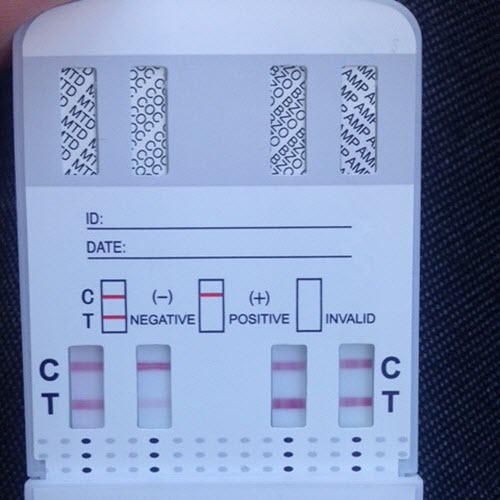
The intensity of the line on a drug test result is not an indication of how much of a drug is present in that person. The intensity of the colour of that line is not important. A line that is only faint is still a line and a faint line in the “T” area of the drug test indicates that the result of the test is negative.
As can be seen in the photo of a negative test shown above, the COC strip is a faint line on a drug test that is much lighter in colour than the other test strip, however the test result is still negative.
Understanding Test Line Chemistry
While a faint line might worry you, understanding the science behind drug test strips can put your mind at ease. These tests work through a clever chemical reaction called competitive binding. Think of it like a game of musical chairs – drug metabolites and test chemicals compete for limited binding spots on the test strip. When you’ve got drugs in your system above the cutoff level, they hog all the binding spots, preventing the test line from appearing at all. But here’s the interesting part: even tiny amounts of the test chemicals finding their way to those binding spots will create a visible line, no matter how faint.
You might wonder why manufacturers don’t just make all test lines equally dark. They can’t – it’s simply not possible given how the chemistry works. Just like adding food colouring to water, the intensity depends on concentration. Sometimes you’ll see darker lines when your urine is more concentrated, typically first thing in the morning. Later in the day, when you’re well-hydrated, those same test strips might show fainter lines. What matters isn’t how dark the line appears, but whether it shows up at all within the test window.
Variations in colour intensity are normal for lateral flow drug tests that are based on urine and saliva and should not be a cause for concern. Because of the nature of the physiological liquids being tested, it is not uncommon for the colour intensity to vary. This can be true even for the same person testing at different times on the same day.
The more experienced you become in taking these types of tests, the more you will learn to understand that these changes are to be expected. The most important thing is that the test results are interpreted within the manufacturer’s specified read time to determine the positive / negative result.
Questions about a faint line on a drug test are one of the most common ones we receive. Manufacturers of the tests have also confirmed that the intensity of the line colour on the test is not important. The presence of a line in the “T” region on the drug test, whether it be very dark or very light, means that the test is negative.
Responsible Drug Testing
Drug testing can be a useful tool for employers, schools, and parents when done responsibly. According to ACAS guidance on substance abuse at work, it is important to understand the limitations of drug tests and use the results appropriately. Urine drug tests cannot determine frequency of drug use, when the drug was last taken, or whether the individual is impaired. A positive test only indicates past drug exposure. A faint line may simply mean a very low level of metabolites that is still above the cutoff level.
Rather than immediately punishing a positive test, the first step should be an open conversation. Find out if the drug use was accidental or unknowing. Prescription drugs, CBD products, herbal supplements, and food like poppy seeds can cause unexpected positives. Some people may use drugs occasionally recreationally without having a substance abuse problem.
Understand why the drug use occurred before deciding how to handle the situation. Provide education, counselling, and support. With teenagers in particular, overly harsh punishments can be counterproductive. A more compassionate approach is usually more effective at reducing future drug use. For more information on workplace drug testing policies, consult your HR department or employment law advisor.
Drug testing policies and procedures should be clearly communicated to those being tested. Random testing and observed specimen collection can seem invasive if expectations were not set beforehand. Ensure proper informed consent while protecting individual privacy as much as possible.
When setting drug testing policies, carefully consider the costs versus benefits. Drug testing programmes can be expensive to implement and maintain. The impacts on employee morale and retention, student achievement, and family relationships should be weighed. Focus on safety-sensitive positions and reasonable cause testing to avoid overreach, as recommended by SAMHSA (Substance Abuse and Mental Health Services Administration).
Drug testing can play a role in creating healthy and safe environments when applied judiciously. However, urine drug tests have limitations. A reasonable, fair, and evidence-based approach serves everyone best.
What A Faint Line Means
- A faint line on a drug test still constitutes a negative result as long as it appears in the test area. The intensity of the line colour does not matter.
- Variations in line faintness are normal. Differences can occur between tests of the same urine sample or tests of the same person at different times of day.
- Many factors impact line intensity including urine concentration, lighting, manufacturing variation, and subjective perception of colour. A test reader’s vision and point of view affects how dark the line appears.
- The key is that even a very faint line signifies that the drug metabolite level in the urine is below the cutoff level. The line does not need to be darker than the control line to be considered negative.
- However, if no line at all appears where a test line should show up, then the result is positive. A complete absence of a test line indicates the drug level exceeds the cutoff concentration.
- Home drug tests state results may not be reliable after a certain time period, often around 5 minutes. Reads after the recommended duration are more likely to show faint lines. Earlier reads within the time window will show the proper result.
- A faint line appearing after the approved read window does not necessarily mean a negative result. The outcome may be ambiguous if test instructions were not properly followed.
- Retest with a new drug test rather than making assumptions if a faint line appears only after the recommended duration or there are any other questions about the result.
- While urine drug tests are highly accurate when used correctly, they are screening tools that sometimes need confirmation testing for more definitive answers in unclear cases.
What Customers Say
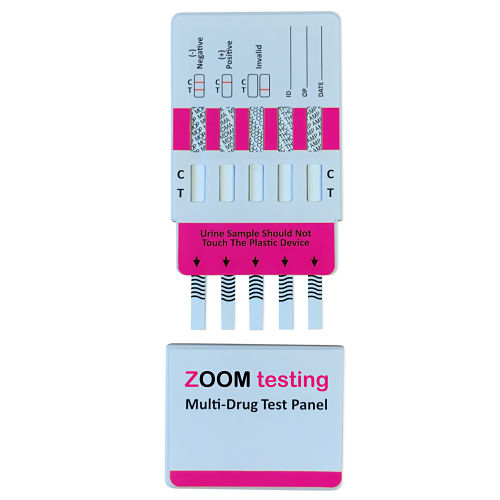
Take Action: Shop our range of multi-drug dip cards and other testing kits for reliable results you can trust.
Real customers have shared their experiences with understanding faint lines on test results:
Lloyd R – “I was a bit concerned by the results of this cannabis test when I first had a go using one. The test line came up really, really faint. I had made sure that I’d not smoked for a while so I was worried that the drugs test was a fail or borderline. With a pre-employment test coming up I was bricking it! Luckily, rather than worry myself to death I actually contacted Zoom Testing by email. They assured me that ANY line in the test area is a NEGATIVE and it does not matter if it is FAINT or STRONG. Also how intense the colour of the line is is also not an indicator of a how much drugs is left in your system. The testing guys were really helpful and to cut a long story short, I did pass my drugs test at work, but I was very worried for a little while.”
⭐⭐⭐⭐ 4/5
Trevor S – “Needed to check as have a medical coming, worked as stated but really hard to see the second band for the negative reading. The control band was very easy to see the THC band was so faint that I had to really study the screen, however as my medical came back as negative it worked.”
⭐⭐⭐⭐⭐ 5/5
About the Author
Anthony Cunningham – Drug Testing Expert & Editor
Anthony Cunningham, BA (Hons), MA, is a UK-based drug testing expert and editor with over 20 years’ experience running Zoom Testing, a trusted source for accurate drug testing kits and testing guidance. He creates clear, evidence-based articles using UK legislation, workplace compliance standards, and harm reduction best practices. Where possible, content is reviewed by testing specialists and compliance professionals to enhance accuracy and reliability, helping readers make informed testing decisions.
You May Also Like: