Published: 28 August 2026 | Last Updated: 28 August 2026 | By Anthony Cunningham
This week’s drug testing industry roundup looks at the stories most relevant to UK employers, families and testing professionals. With nearly 20 years of experience in professional drug testing, Zoom Testing reviews the week’s developments and explains what they may mean in practice.
The strongest theme in this week’s drug and alcohol news is not simply increased drug availability. It is the growing difficulty of knowing exactly what people are taking, combined with changing attitudes towards harm reduction, prescribed substances and workplace responsibility.
From record ketamine seizures to drug checking at music events, drink spiking and new approaches to medical cannabis, employers are increasingly operating in an environment where a simple “drug-free workplace” statement is not enough. Policies need to distinguish between illegal drug use, prescribed medication, impairment, safeguarding and the practical risks associated with safety-critical work.
For UK employers, the lesson is clear: testing remains important, but it works best when it sits within a wider framework of proportionate policy, education and risk management.
Drug Checking Moves Further Into The Mainstream
A BBC report this week asked whether drug testing at music events could play a greater role in reducing harm. Tackling the ‘war on drugs’: Could testing at gigs work? looked at the availability of rapid drug identification facilities at events elsewhere in the UK and Ireland, compared with Northern Ireland.
The significance goes beyond festivals.
Drug checking is based on a recognition that the substance somebody believes they have bought may not necessarily be what they actually possess. That uncertainty is becoming increasingly important as synthetic drugs, adulterants and high-strength substances circulate through illicit markets.
Employers face a different environment from festival organisers, but the underlying principle is relevant. A workplace drug test does not determine whether somebody is a “drug user” in a broad moral sense. It identifies whether particular substances or metabolites are present above defined thresholds.
That distinction matters when creating a credible Workplace Drug Testing programme. Employers should be clear about which substances are being tested for, why those substances are relevant to workplace safety and what will happen following a non-negative result.
The uncertainty within illicit markets was reinforced by another major story this week. Border Force seized almost 1,300kg of ketamine during the first three months of 2026, according to figures reported by ITV News. The quantity was described as the highest recorded in 15 years.
For employers, seizure figures should not be interpreted as a direct measure of workplace drug use. They do, however, illustrate how established some recreational drug markets have become.
Ketamine can therefore no longer be regarded as a niche substance relevant only to a narrow section of the population. Organisations reviewing their testing panels should consider their own workforce, sector, location and risk profile rather than relying on assumptions about which drugs employees are most likely to encounter.
Our guide to What is Ketamine? provides further background on the drug and its effects.
Drink Spiking Is Becoming A Wider Safeguarding Issue
New figures highlighted by Talk About Trust provide another reminder that drug and alcohol risks do not always involve deliberate consumption.
The organisation’s report on new UK data on drink spiking says that more than 30% of people who are spiked are male and highlights a concerning increase in reports involving vapes and e-liquids. It also points to a significant increase in reported incidents during 2025.
This broadens the safeguarding conversation.
Drink spiking is commonly associated with nightlife and alcohol, but employers should recognise that the consequences may continue into the workplace. An employee who believes they have been spiked may arrive at work feeling unwell, confused or impaired without initially understanding why.
That is particularly important in transport, manufacturing, construction, healthcare, warehousing and other safety-sensitive environments.
Managers therefore need to be capable of responding to impairment without immediately assuming misconduct. Removing somebody temporarily from safety-critical duties may be entirely appropriate while the cause is investigated, but the circumstances surrounding the incident still matter.
Testing can support that investigation, although timing, the substance involved and the type of test used will affect what can be detected. Employers considering different approaches can read our guide to The 5 Common Ways To Test For Drugs And Alcohol.
The broader message is that workplace drug and alcohol procedures should include safeguarding as well as discipline.
Medical Cannabis Creates A Different Policy Challenge
One of the more significant developments this week came from Devon, where an NHS trust has introduced formal protection allowing hospital patients prescribed medical cannabis to continue taking their legal medication during inpatient care.
The medical cannabis policy reported by the Exmouth Journal was described as the first of its kind in England.
This is particularly relevant to employers because cannabis testing can produce situations where a legitimate prescription and a workplace testing policy intersect.
A positive or non-negative cannabis result does not, by itself, explain why cannabis is present or establish whether an employee is impaired at that particular moment.
That does not mean employers should ignore cannabis where safety is concerned. It means policies need to be sufficiently mature to deal with prescribed medication separately from unauthorised drug use.
Employees may need to disclose medication where it could affect their ability to perform a safety-critical role. Employers, in turn, need a consistent process for assessing the occupational risk rather than automatically treating the presence of a controlled drug as misconduct.
This is one reason testing policies should specify their purpose clearly. Testing intended to deter prohibited drug use is not exactly the same as testing designed to manage immediate impairment risk.
Dependence, Overdose And The Limits Of Punishment
International Overdose Awareness Day takes place on 31 August, and WithYou used its 25th anniversary to call for further action on preventable drug-related deaths.
Its statement, 25 Years of International Overdose Awareness Day, highlights education, systemic change and wider access to naloxone.
This has relevance to workplace policy too.
Drug testing frequently appears within disciplinary procedures, but employers should avoid designing systems where punishment is the only possible response. An employee whose drug use has developed into dependency may require occupational health assessment, treatment or support as well as appropriate management of workplace risk.
There will still be circumstances where disciplinary action is necessary, particularly where safety rules have been deliberately breached. The point is that organisations should know in advance how they will distinguish between misconduct, dependency, prescribed medication and an immediate fitness-for-work concern.
A highly publicised case this week also demonstrated how difficult those distinctions can become. The Independent reported that a private school teacher was banned from teaching after using crystal methamphetamine. He reportedly told his employer he had used the drug to relax and considered his use controlled.
Whatever the circumstances of an individual case, descriptions such as “recreational”, “occasional” or “controlled” should not replace an objective workplace risk assessment.
What UK Employers Should Take From This Week
The major stories this week point in the same direction. The UK drug environment is becoming more complicated, not less.
Drug checking at festivals reflects uncertainty about the contents of illicit substances. Record ketamine seizures demonstrate the scale of established drug markets. Spiking creates situations where somebody may have consumed a substance unknowingly. Medical cannabis introduces legitimate controlled-drug use into employment discussions, while overdose awareness reinforces the need to recognise dependency as more than simply a disciplinary problem.
A good workplace drug and alcohol policy therefore needs to answer practical questions before an incident happens.
Employers should know which substances they test for, when testing can be carried out, how results will be confirmed, how prescribed medication will be handled and what happens when somebody appears unfit for work.
The policy should also explain the difference between a test result and evidence of impairment.
Testing remains a valuable tool, particularly in safety-sensitive environments, but it should form part of a wider system that includes clear rules, trained managers, appropriate investigation and consistent decision-making.
The objective is not simply to catch people taking drugs. It is to manage workplace risk fairly, reliably and proportionately.
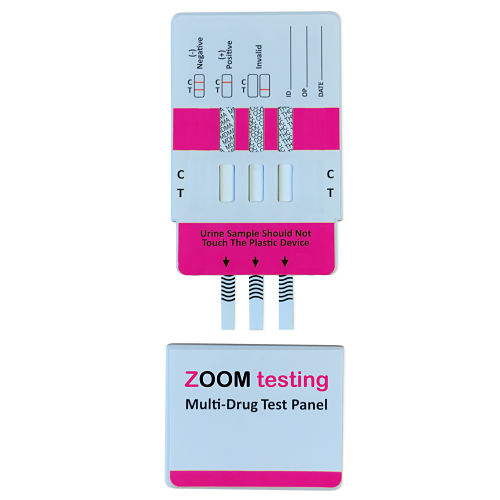
Take Action: 3 Panel Drug Test for Cannabis, Cocaine & Speed
For clear, practical testing at home or in the workplace, our 3 Panel Drug Test for Cannabis, Cocaine & Speed provides fast and simple THC screening when you need a reliable answer.
What Customers Say
★★★★★
“I needed to take a drug test at work although I had given up smoking cannabis,I bought the kit to make sure it had all left my body. The test worked and it was confirmed when I took the test at work. Small price to pay for peace of mind!”
– michael m · Verified review
★★★★★
“I’ve never taken drugs or used a drug test before so it was a bit intimidating at first but I contacted Zoom Testing and they were very helpful in pointing me in the right direction. I was worried about my son who had been smoking cannabis. The test was simple to use and I now have peace of mind knowing that he is no longer using the drug. Also allowed me to confirm that he was not using anything else. Good deterrent too, as he knows that he can be tested at any time.”
– Tina · Verified review
★★★★★
“Very simple and straightforward test to use, just follow the instructions that come with the cannabis test and you will soon see a clear positive or negative test result. Bought this kit as I am applying for jobs where I know that I will be tested for drugs as part of the selection process. My only vice is occasionally smoking weed, however I was certainly concerned that my usage would be enough for me to fail a drug test. The first test I took came back positive. I took this test maybe two and a…”
– Julian R · Verified review
About the Author
Anthony Cunningham – Drug Testing Expert & Editor
Anthony Cunningham, BA (Hons), MA, is a UK-based drug testing expert and editor with over 20 years’ experience running Zoom Testing, a trusted source for accurate drug testing kits and testing guidance. He creates clear, evidence-based articles using UK legislation, workplace compliance standards and harm reduction best practices. Where possible, content is reviewed by testing specialists and compliance professionals to enhance accuracy and reliability, helping readers make informed testing decisions.