Published: 5 June 2026 | Last Updated: 6 June 2026 | By Anthony Cunningham
This week’s drug testing industry roundup covers significant developments in UK workplace safety, a sharp rise in ketamine-related harms, the alarming spread of drug-laced vapes into schools, ultra-strength cocaine hitting UK streets, and a milestone anniversary for the Misuse of Drugs Act. With nearly 20 years of experience in professional drug testing, we’ve analysed the week’s most important stories to help UK employers stay informed and compliant.
The Ketamine Crisis Deepens – and Employers Need to Pay Attention
If there was a single theme running through this week’s news, it was ketamine – and not in a positive way. The drug has been quietly growing in popularity for years, particularly among younger people, and the consequences are now impossible to ignore.
A personal account published by the BBC on Friday brought home the very human cost. Ellie Wight started taking ketamine at 18, thinking it was a safer choice compared to other substances. Five years later, aged 23, she has permanent bladder damage. Her story is striking precisely because it will resonate with many young people who hold the same mistaken belief about the drug’s relative safety.
The same day, Metro reported on a 22-year-old estate agent who died after her weight dropped to just five stone as a result of ketamine addiction. An inquest heard she had discharged herself from hospital shortly before her death.
On Thursday, a Comment Central analysis put the scale of the problem in context: the number of annual ketamine users in England and Wales has doubled to around 300,000 in under a decade, while the number seeking treatment for ketamine-related problems has increased more than eightfold over the same period. Young people are disproportionately affected.
The House of Commons Library added to this picture on Thursday with a new Research Briefing on Ketamine, confirming that use is increasing and that concerns about the harms of misuse are well-founded. For employers – particularly those in industries where alertness and coordination matter – this is a drug that can no longer be treated as a fringe concern. The ability to detect how long ketamine stays in a person’s system is something every workplace drug testing policy should now account for.
Scottish data underscored the same trend earlier this week: a freedom of information request revealed almost 1,600 A&E and hospital admissions related to ketamine across Scotland in just four years, according to Edinburgh Live.
Drug-Laced Vapes in Schools – a Problem That’s Getting Worse
A story that broke this week should alarm anyone responsible for young people’s welfare. According to the BBC, more than a quarter of children across Blackburn and Darwen have used a vape laced with drugs, based on a recent health survey. The drugs in question include spice – one of the synthetic cannabinoids that can cause extreme and unpredictable reactions.
ITV News reported that a boy of 12 was put into a coma after using one of these products. Research from the University of Bath found that as many as one in four confiscated vapes from schools contain spice, and a network of 10,000 social media accounts has been identified as linked to the sale of these products to children.
This is not a new threat – but it is an escalating one. Schools now have access to school drug prevention products specifically designed to help identify substance use, and this week’s coverage makes a strong case for their use. The ability to test for spice is increasingly relevant not just for schools but for any employer whose workforce may include younger adults.
Separately, the vaping landscape more broadly is in flux. Monday brought news from Durham Police about the seizure of suspected Mazza vapes – liquids thought to contain fentanyl – with the BBC warning young people to be alert to illicit vapes circulating on the market. The term “Mazza” refers to unregulated vape liquids that may contain nicotine, cannabis or other substances entirely.
Ultra-Strength Cocaine and Record Death Tolls
This week the Independent carried a stark headline: ‘ultra-strength’ cocaine is now hitting UK streets, with more than 1,000 people dying from cocaine last year – a record high. The surge in purity is linked directly to a production boom in Latin America.
This matters for employers. Cocaine drug testing in the workplace is not a niche concern – cocaine consistently features as one of the most commonly detected substances in occupational testing programmes. The higher purity of street cocaine means the risks for users are greater than ever, and the argument for robust detection measures in safety-critical roles has never been stronger. Understanding how long cocaine stays in the system is a practical starting point for any employer building a testing policy in line with ACAS guidance on drug and alcohol testing at work.
Also from Wednesday, a study published by the Irish Examiner found that 23% of Irish 20-year-olds had used cocaine in the previous year – part of a wider picture of significant polydrug use among young adults in Ireland. The same cohort showed substantial rates of cannabis, ecstasy and ketamine use. While the data comes from Ireland, UK trends tell a similar story.
Festival Season Warnings: ‘Pink Powder’ Drugs and Mixed Substances
Monday opened with a public health warning from Northern Ireland’s Public Health Agency, covered by the BBC, about so-called “pink powder” drugs circulating ahead of festival season. Despite sometimes being marketed as “pink cocaine”, these powders rarely contain cocaine at all. Instead, they are typically a mix of very high-strength MDMA, ketamine and other substances. The PHA’s message was blunt: “If it’s pink, stop and think.”
This kind of adulteration is exactly why drug checking matters – and why comprehensive multi-panel testing makes sense for employers who may need to screen for a broad range of substances simultaneously. With festival season in full swing, the weeks ahead are likely to see increased circulation of novel and adulterated drug products.
There was also a parliamentary intervention on this topic Thursday, when a Northern Ireland Assembly question raised by MLA Gary Harvey challenged the Public Health Agency over a social media post that appeared to advise festivalgoers to “start with a small dose” when taking drugs – as recorded on They Work For You. The post provoked significant controversy.
55 Years of the Misuse of Drugs Act – Fit for Purpose?
Thursday marked the 55th anniversary of the Misuse of Drugs Act 1971, and it prompted an Early Day Motion in Parliament. The EDM, tabled on 2 June and signed by five MPs, stated plainly that the Act “has failed to reduce drug consumption” and that “drug deaths are now at a record high.” It called the legislation “clearly not fit for purpose”, arguing that it has “increased harm, damaged public health and exacerbated social inequalities.”
Predictably, this generated debate. Portugal’s approach – which decriminalised personal possession in 2001 – featured prominently in a BBC audio piece on Thursday asking whether that model is now in need of its own reform, more than two decades on.
Whatever your view on drug policy, the practical reality for UK employers remains unchanged: the current legal framework means that workplace drug use carries real legal and reputational consequences, and having a clear, consistent testing policy is both good practice and good risk management. The basics of workplace drug testing are well established, and the ACAS framework provides a solid foundation for any employer looking to implement or review their approach.
Drug Use Behind Bars: Persistent Problems
Two separate stories this week highlighted the ongoing challenge of drug use in prisons. On Tuesday, the BBC reported that inspectors found psychoactive drugs were “freely available” at one prison, alongside very high levels of self-harm among inmates. On Wednesday, a prison worker – a corrupt watchdog boss – was jailed for smuggling cannabis into prison for a serving killer. And Thursday brought news of needles linked to drug use found in a car park in Northern Ireland, near a children’s play area.
Meanwhile in the US, Texas prisons are implementing a ban on hardback and used books after hundreds of inmates tested positive for synthetic drugs – the books themselves reportedly being used to smuggle in drug-laced paper, according to the Independent.
Nitazene Deaths: A Reminder of Emerging Threats
This week the National Crime Agency confirmed that a drug supplier linked to at least two nitazene deaths has admitted a raft of criminal charges. Nitazenes are a class of highly potent synthetic opioids – some significantly more powerful than fentanyl – that have been appearing in the UK supply chain in recent years. They represent a serious and growing public health threat, particularly because users may not know they are consuming them.
Standard drug testing panels do not always capture these newer synthetic opioids, which is why panel coverage matters when selecting a workplace test. Employers in high-risk environments should consider whether their current testing capability is adequate to detect the full spectrum of substances now in circulation.
Smoking, Vaping and Tobacco: A Busy Week
On the tobacco and vaping front, this was a particularly eventful week. ASH published two significant pieces of research: their annual analysis putting the cost of smoking to England’s society at £44.8 billion per year, and a YouGov survey confirming that disposable vape use among 11-17-year-olds has fallen sharply since the ban – from 42% using them in 2025 to just 13% in 2026. The one-year anniversary of that ban also made news this week, with the Responsible Vaping APPG broadly positive in its assessment of progress.
For employers with smoking policies or nicotine testing requirements, the government’s Stop Smoking Service Data Explorer was also updated this week, providing the latest analysis on smoking prevalence and stop-smoking service performance.
Key Takeaways for UK Employers This Week
It’s been a week dominated by emerging and escalating drug threats rather than settled ones. A few things stand out for anyone managing a workforce:
Ketamine is not a niche issue. The volume of news this week – from the Commons Library briefing to personal testimonies to Scottish hospital admission data – signals that ketamine use among working-age adults has reached a level where employers cannot afford to overlook it. If your testing policy doesn’t include ketamine, it’s worth reviewing.
Drug-laced vapes are a gateway risk. Young workers may have been exposed to drug-laced vapes without fully understanding what they consumed. This changes the context around positive drug tests and reinforces the importance of clear, supportive workplace policies that distinguish between intentional use and potential unknowing exposure.
Cocaine purity is rising. Record-high deaths and record-high purity levels mean the risks associated with cocaine use are greater than ever. What happens when someone fails a drug test at work should be clearly set out in your policy – and your workforce should be aware of it.
Comprehensive testing makes more sense than ever. With cocaine, ketamine, spice, MDMA and novel synthetic opioids all featuring in this week’s news, a multi-substance approach to workplace testing is increasingly the only sensible option. Comparing 12 vs 18 panel test kits is a useful starting point for any employer thinking about upgrading their screening capability. For guidance on your broader obligations, ACAS’s guidance on drug and alcohol testing at work remains the essential reference.
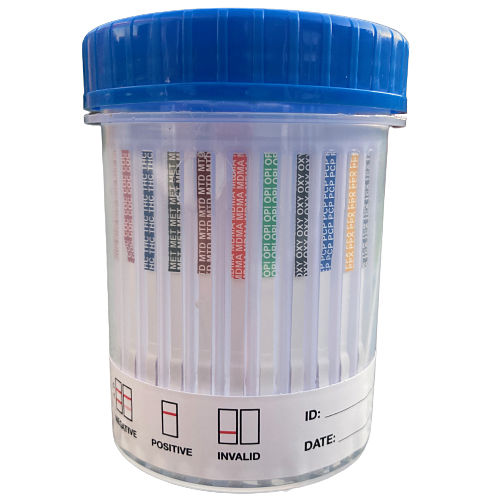
Take Action: Comprehensive 18-Panel Drug Testing
With ketamine, cocaine, spice and synthetic opioids all making the headlines this week, there has never been a stronger case for comprehensive workplace screening. Our 18-panel drug test with integrated cup screens for 18 substances in a single, self-contained test – fast, accurate and simple to use.
What Customers Say
“I was really pleased to find this as I needed a comprehensive drug test kit and this is the biggest one that I could find. Price was very reasonable and the test arrived quickly. I found it to be an easy to use product with clear instructions. Results were quick and simple to interpret.”
– Jason
“Thank you to the team at Zoom Testing for advice before buying this drug test kit. I was looking for something that was easy to use and gave accurate results, in line with any workplace drug test. This kit did both and I was pleased to receive it within 24 hours of ordering. Using the test gave me great peace of mind, and I went from stressed to relaxed in just one day!”
– Jore
“I bought these to test my PCV Drivers and they worked very good. Delivery was very fast and they were very quick at replying to any queries when e-mailed. Will be using them again in the future if needed and are highly recommended.”
– Kayleigh R
About the Author
Anthony Cunningham – Drug Testing Expert & Editor
Anthony Cunningham, BA (Hons), MA, is a UK-based drug testing expert and editor with over 20 years’ experience running Zoom Testing, a trusted source for accurate drug testing kits and testing guidance. He creates clear, evidence-based articles using UK legislation, workplace compliance standards, and harm reduction best practices. Where possible, content is reviewed by testing specialists and compliance professionals to enhance accuracy and reliability, helping readers make informed testing decisions.
You May Also Like: