Published: 17 July 2026 | Last Updated: 17 July 2026 | By Anthony Cunningham
This week’s drug testing industry roundup looks at the stories most relevant to UK employers, families and testing professionals. With nearly 20 years of experience in professional drug testing, Zoom Testing reviews the week’s developments and explains what they may mean in practice.
This week’s news put a spotlight on where the UK is heading on drugs policy, and the picture is not simple. Bristol has become the country’s first officially declared “city of harm reduction,” while Border Force is warning that criminal gangs are recruiting young people with the promise of cheap holidays to move drugs across borders. Add in a near-doubling of illicit tobacco purchases since 2023, a global ban on vape sales by Shopify, and a World Cup awash with alcohol sponsorship, and the direction of travel becomes clearer: informal and illegal drug and alcohol supply is adapting fast, even as official policy tries to soften its response to use itself.
For UK employers, this matters. Workplace risk does not sit neatly inside company walls. It follows employees home, onto the school run, into recruitment pools of younger staff, and into the culture around major sporting events. This week’s stories are a reminder that good Workplace Drug Testing policy has to keep pace with a fast-moving landscape, not just react to it.
Bristol’s Harm Reduction Declaration and What It Means for Employers
Bristol councillors have voted to designate the city as the UK’s first official “city of harm reduction,” a move explicitly framed around supporting drug users rather than punishing them (BBC). The decision paves the way for a potential drug consumption facility where people who use drugs can be helped and treated (Guardian).
This is a significant local policy shift, and it sits within a wider pattern. The Loop continues to run drug checking services across Bristol and three London locations, giving people rapid, accurate information about what is actually in circulation, alongside non-judgemental support from health professionals (The Loop).
None of this changes UK employment law. Harm reduction as public health policy and drug testing as workplace risk management are not in conflict, but they are also not the same thing. A city adopting a more supportive stance towards people who use drugs does not reduce an employer’s duty of care, particularly in safety-critical roles. If anything, as harm reduction becomes more visible and normalised in public debate, HR and Health & Safety teams may need to be clearer, not vaguer, about where the workplace line sits. A written policy that explains What Happens If You Fail A Drug Test At Work? gives staff certainty even as the public conversation around drug use continues to shift towards support rather than punishment.
The practical takeaway is that employers should treat harm reduction policy and workplace testing policy as two separate, non-competing tracks. One protects public health. The other protects colleagues, customers and the business from the consequences of impairment at work.
Young Workers, Cheap Holidays, and the Risk Gangs Are Exploiting
Border Force has warned that criminal gangs are targeting young people with offers of cheap holidays in exchange for smuggling drugs, with more than 600 passengers already arrested at UK airports in 2026 (Independent). The recruitment is happening on TikTok and Instagram, platforms that most employers with a younger workforce, from hospitality and retail to logistics and apprenticeships, will already be familiar with as a channel their staff use daily.
This is not a drug testing story so much as a duty of care story, but the two are connected. Employers with seasonal, graduate or apprentice intakes should be alert to the fact that some of the same young people entering the workforce this summer are being actively targeted online with offers that carry serious criminal and personal risk. It is worth reminding line managers that safeguarding conversations with younger employees are not old-fashioned. They are increasingly necessary.
Where this connects back to testing is at the point of recruitment and return-to-work. Pre-employment and post-incident screening remain one of the few objective tools an employer has, and understanding The 5 Common Ways To Test For Drugs And Alcohol helps HR teams choose proportionate, defensible methods rather than blunt, one-size-fits-all approaches.
Illicit Supply Chains Are Growing, From Tobacco to Vapes
Two stories this week point to the same underlying trend: illegal and unregulated supply is expanding, even in categories that are legal to buy through proper channels. UCL research found that the proportion of UK smokers buying cigarettes or tobacco from illicit sources has almost doubled since 2023 (UCL). Meanwhile Shopify has ordered merchants worldwide to remove all vape products from their online stores, extending a US crackdown into a global ban (Clearing the Air).
Taken together, these stories describe a market where legitimate retail is tightening at exactly the moment illicit supply is growing to fill the gap. That pattern rarely stays confined to tobacco and nicotine. It is a useful reminder for occupational health and HR teams that products sourced outside regulated channels, whether tobacco, vapes, or other substances, carry unknown composition and unpredictable effects. Employers updating workplace substance policies may find it helpful to revisit What Are Synthetic Cannabinoids? as an example of how quickly unregulated products can appear and change in potency without any corresponding change in how confident an employee feels about what they have taken.
Briefly This Week
- High-caffeine energy drinks banned for under-16s. Following a 12-week consultation, the government has confirmed a ban on selling drinks with more than 150mg of caffeine per litre to under-16s, covering shops, cafes, online sellers and vending machines (DHSC).
- Clouds House marked 43 years of recovery. Forward Trust’s Wiltshire treatment centre held its annual reunion, bringing together alumni, families and staff to mark decades of recovery work (Forward Trust).
- Australia’s smoking rate hit a historic low. Daily smoking fell to 5.6%, down from 8.3% two years earlier, even as illicit tobacco use rises there too, a useful comparator for the UK’s own illicit tobacco trend above (Guardian).
What UK Employers Should Take From This Week
The thread running through this week’s news is that drug and alcohol risk is becoming more decentralised. It is moving through social media recruitment, informal retail channels and global platforms, at the same time as UK cities like Bristol are adopting more supportive, public-health-led responses to use itself. Neither trend removes an employer’s responsibility to manage risk in the workplace. If anything, both make clear policy and reliable testing more important, not less.
Employers do not need to take a public position on harm reduction as a philosophy to have a robust, fair, and legally sound workplace testing policy. What they do need is clarity: a written policy, a consistent process, and testing methods that match the risk profile of the role. For safety-critical or customer-facing positions, that might mean revisiting Alcohol and Drug Testing in the Professional Workplace to check the policy still reflects current substances and current risks, not just the ones that were common when it was first written.
It is also worth remembering that policy clarity protects employees as much as employers. A young member of staff targeted online by a gang, or a colleague who has bought an unregulated vape or tobacco product without knowing its origin, benefits from a workplace culture that is honest and consistent about consequences, support, and where to go for help. That combination, clear expectations paired with genuine support, is likely to matter more in the months ahead, not less.
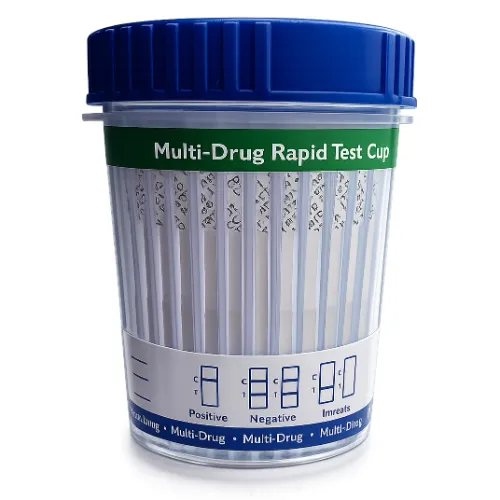
Take Action: Zoom Testing Multi-Drug Rapid Test Cup (22-Panel)
For clear, practical testing at home or in the workplace, our Zoom Testing Multi-Drug Rapid Test Cup (22-Panel) provides fast and simple THC screening when you need a reliable answer.
What Customers Say
★★★★★
“I needed to take a drug test at work although I had given up smoking cannabis,I bought the kit to make sure it had all left my body. The test worked and it was confirmed when I took the test at work. Small price to pay for peace of mind!”
– michael m · Verified review
★★★★★
“I’ve never taken drugs or used a drug test before so it was a bit intimidating at first but I contacted Zoom Testing and they were very helpful in pointing me in the right direction. I was worried about my son who had been smoking cannabis. The test was simple to use and I now have peace of mind knowing that he is no longer using the drug. Also allowed me to confirm that he was not using anything else. Good deterrent too, as he knows that he can be tested at any time.”
– Tina · Verified review
★★★★★
“Very simple and straightforward test to use, just follow the instructions that come with the cannabis test and you will soon see a clear positive or negative test result. Bought this kit as I am applying for jobs where I know that I will be tested for drugs as part of the selection process. My only vice is occasionally smoking weed, however I was certainly concerned that my usage would be enough for me to fail a drug test. The first test I took came back positive. I took this test maybe two and a…”
– Julian R · Verified review
About the Author
Anthony Cunningham – Drug Testing Expert & Editor
Anthony Cunningham, BA (Hons), MA, is a UK-based drug testing expert and editor with over 20 years’ experience running Zoom Testing, a trusted source for accurate drug testing kits and testing guidance. He creates clear, evidence-based articles using UK legislation, workplace compliance standards and harm reduction best practices. Where possible, content is reviewed by testing specialists and compliance professionals to enhance accuracy and reliability, helping readers make informed testing decisions.