About This Article
Zoom Testing has provided drug testing information and guidance for over 20 years. This article preserves our November 2018 reporting on drug-driving incidents involving taxi drivers in Merseyside, with relevant legal information reviewed for accuracy.
Originally published: 15 November 2018 | Reviewed: 7 November 2026 | By: Anthony Cunningham
From the Zoom Testing Archive: Originally published on 15 November 2018, this article records drug-driving incidents and police warnings reported in Merseyside at that time. Drug-driving legislation, penalties and testing procedures may have developed since publication. For current drug testing information and guidance, please see our latest articles.
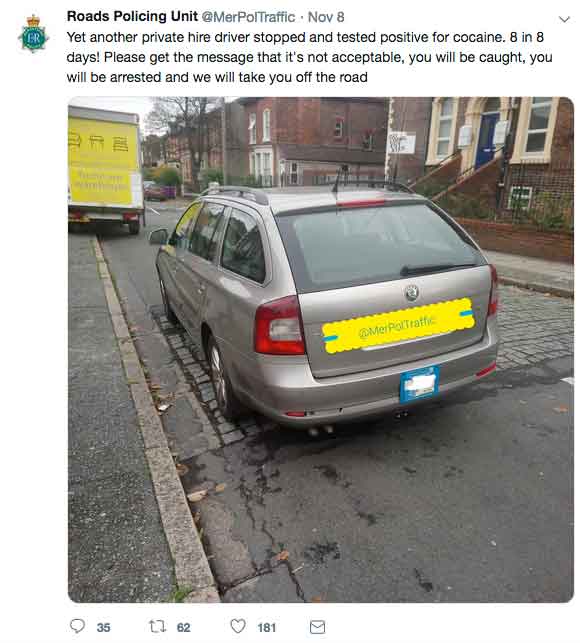
In November 2018, concerns were growing about drug-driving among taxi drivers in Merseyside, following another incident involving a private hire driver in the Liverpool area. Testing positive for cocaine, this driver was reported to be the eighth in the Merseyside area to test positive for cocaine usage. Indeed, this was reported to be the 40th driver to be arrested for taking cocaine when driving since January 2018, an alarming statistic which caused the police to deliver stern warnings via Twitter.
Indeed, one driver tested positive for three different substances, whilst having a passenger in the back seat. The driver tested positive for benzoylecgonine, delta-9-tetrahydrocannabinol (THC) as well as cocaine in his system. This took place in June 2018, and the driver was reported to be over 16 times the legal limit for benzoylecgonine.
Naturally, driving while under the influence of drugs is a very dangerous thing to do. Not only is it an offence to drive while impaired by drugs, driving whilst under the influence is likely to impair driving ability and increase your chances of being involved in an accident. Common signs of someone driving whilst under the influence of drugs include:
- Reduced ability to react in time to an unexpected situation.
- Poor vision, leading to blurred vision and misinterpretation of the road or traffic.
- Excessive risk taking and inability to determine when a risk is too serious.
- Inability to judge the speed or distance of another vehicle or a pedestrian.
Driving whilst under the influence of drugs can lead to the loss of employment and even imprisonment. In a worst case scenario, it could lead to the serious injury or even death of another individual through reckless behaviour.
What does driving under the influence mean for me?
For one, if caught you could be arrested. Anyone convicted of drug-driving is likely to face a driving ban of at least 12 months, an unlimited fine and a criminal record. A drug-driving conviction will also normally remain endorsed on their driving licence for 11 years.
This could also see you lose your vehicle, depending on the circumstances. For anyone who relies upon their vehicle for work, this could naturally impair your ability to earn and to make a living. However, should you cause the death of someone when you are driving under the influence of drugs, the consequences can be considerably more serious. For relevant causing-death offences committed from 28 June 2022, the maximum sentence is life imprisonment and the minimum driving disqualification is five years, subject to the applicable legal provisions.
Police may use roadside drug screening equipment and conduct impairment assessments where appropriate. A positive roadside screening result may be followed by an evidential blood test. Alcohol breathalyser tests may also be used where alcohol is suspected, but they do not detect drugs. With the serious consequences for drivers who are under the influence, we recommend that you take no risk. The impact can be life-changing, and not just for yourself but for other people on the roads.
With the likelihood of losing your licence and your livelihood as well as facing jail time, you should consider seriously the implications of driving whilst impaired by drugs or alcohol. Don’t take risks and put yourself or others in danger.
About the Author
Anthony Cunningham, BA (Hons), MA, is a UK-based drug testing expert and editor with over 20 years’ experience running Zoom Testing, a trusted source for accurate drug testing kits and testing guidance. He creates clear, evidence-based articles using UK legislation, workplace compliance standards, and harm reduction best practices. Where possible, content is reviewed by testing specialists and compliance professionals to enhance accuracy and reliability, helping readers make informed testing decisions.