

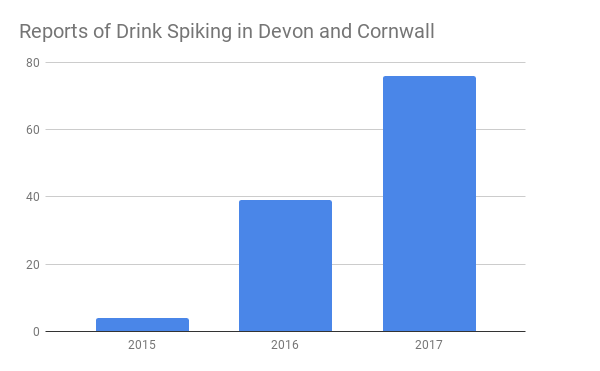
According to police statistics, reports of drink spiking have surged at an alarming rate in recent years. 2015 saw four reports of drink spiking in the Cornwall and Devon areas, increasing to 39 reports in 2016. In an alarming trend, 76 reports of drink spiking events were noted in 2017, showing a 19 times increase in this disturbing practice in the past two years alone.
Police have reiterated that they are investigating the cause of this alarming rise in the incidence of drink spiking and are urging everyone to remain vigilant and do their part in stopping this trend from continuing.
While these figures have concentrated solely on Cornwall and Devon, this area seems to reflect what has become a nationwide trend, with incidents of drink spiking consistently occurring countrywide.
These recent figures have caused police to launch an innovative pilot scheme in Plymouth – the area in which the majority of the reports were made – in order to gain a clear understanding of the disturbing problem. The pilot scheme will see local clubs and bars provided with urine testing kits which, when combined with a well-established CCTV system, will allow first responders to gather vital initial evidence at the scene upon the report of a drink spiking incident.
Early intervention is critical, and this new scheme aims to allow first responding police to identify suspects and establish that an offence has occurred faster than ever before.
Understanding the extent of the U.K.’s drink spiking problem
The symptoms of drink spiking are serious and can include vomiting, confusion, visual problems, loss of balance, and lowered inhibitions.
Looking across the United Kingdom more generally, figures obtained by Sky News under Freedom of information legislation suggest that reports of drink spiking have risen at an alarming rate since 2015, with reports more than doubling in the past few years.
The maximum sentence for a drink spiking conviction is 10 years imprisonment.
Unfortunately, the vast majority of drink spiking incidents do not lead to a conviction. The root cause of this problem is that most incidents of drink spiking are never reported, and those that are reported have the charges abandoned due to lack of evidence or the issue not being taken seriously.
It is thought that many people do not report an incidence of drink spiking because, at the time, they are unaware that it has occurred. This is understandable given that the symptoms of drink spiking can initially appear to be similar to the symptoms of intoxication. It is only after the victim fully understands what has happened – usually the next day – that they are in a position where they can report the drink spiking incident, but by then it is usually too late for suspects to be detained or any evidence to be available.
The setting in which drink spiking occurs can also play a role in a victim’s unwillingness to come forward and report a drink spiking incident. If the incident occurred at a private event, the victim might feel uncomfortable reporting having their drink spiked.
Related Products
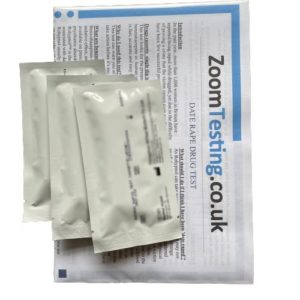
Date Rape ‘DRINK SPIKE’ Tests (Rohypnol Drug)
Original price was: £7.99.£6.99Current price is: £6.99.
Add to basket
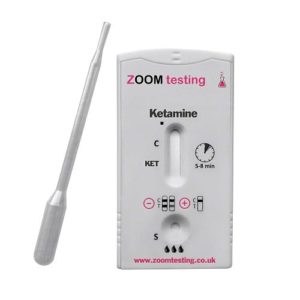
Ketamine Drug Test (KET)
Price range: £2.49 through £28.99
Select options
This product has multiple variants. The options may be chosen on the product page